Case study: 6x search traffic in a year on the Polish market — my first year in IT

Every marketer remembers their first job. Mine started in 2014: my first office, my first IT company, my first position — junior SEO specialist. I was hired mainly because I spoke Polish, and the project was aimed at the Polish market.
In one year and two months on this project, I went through a journey I now consider the foundation of my whole career. And the team I worked in grew search traffic six times over in a year.
The company
Noosphere Ventures is an international technology and investment company with Ukrainian roots, founded by entrepreneur Max Polyakov. It later became known for its space projects: EOS Data Analytics (satellite data analytics) and Firefly Aerospace (rockets). In the mid-2010s, the company was developing internet products for different countries — and that’s where I took my first steps.
For a young specialist it was the perfect school: strong colleagues, demanding standards, real numbers and real responsibility for results. I can’t share the details of the project itself — it’s under a non-disclosure agreement. But I can share the approaches, the numbers and the conclusions.
The task: break through in a competitive foreign market
The niche was extremely competitive: big players with serious budgets were fighting for the top of Google. On top of that, it was a foreign market — a different language, different user behaviour, different donor sites and its own rules of the game.
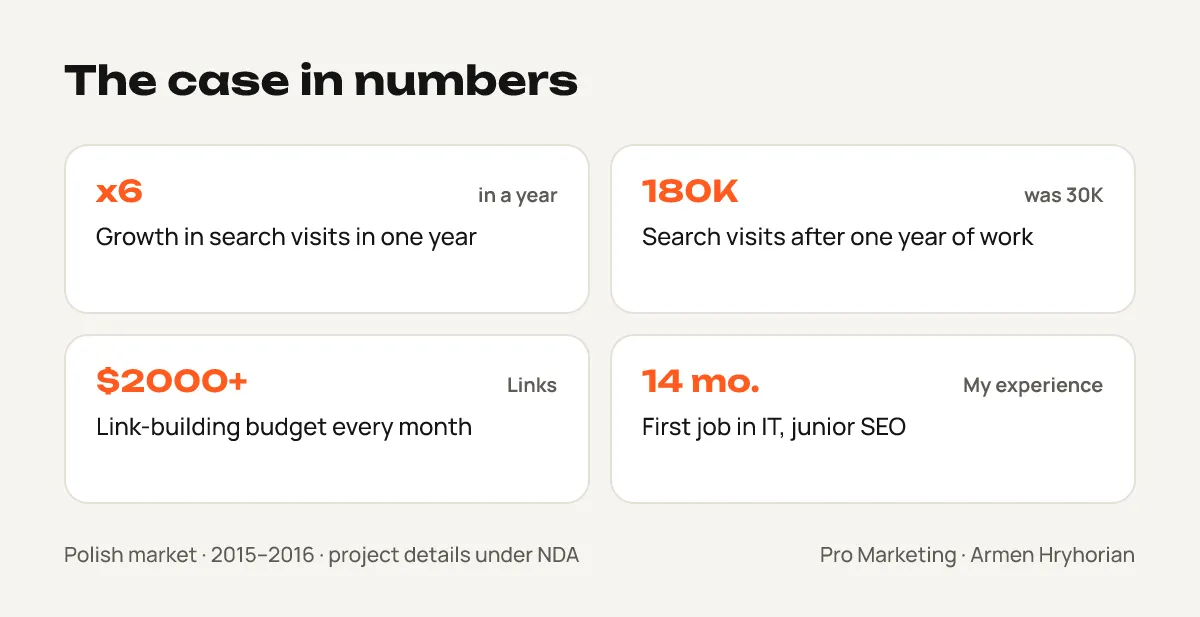
The starting point was about 30,000 visits from search. The task was to multiply organic traffic, because it brought the project its cheapest users.
What we did
My main responsibility was link building — growing the backlink profile, i.e. links to our site from other sites. The link budget was $2,000+ a month, or more than $24,000 a year. For a junior that’s a huge responsibility: every link had to be found, evaluated, negotiated and checked for whether it actually delivered.
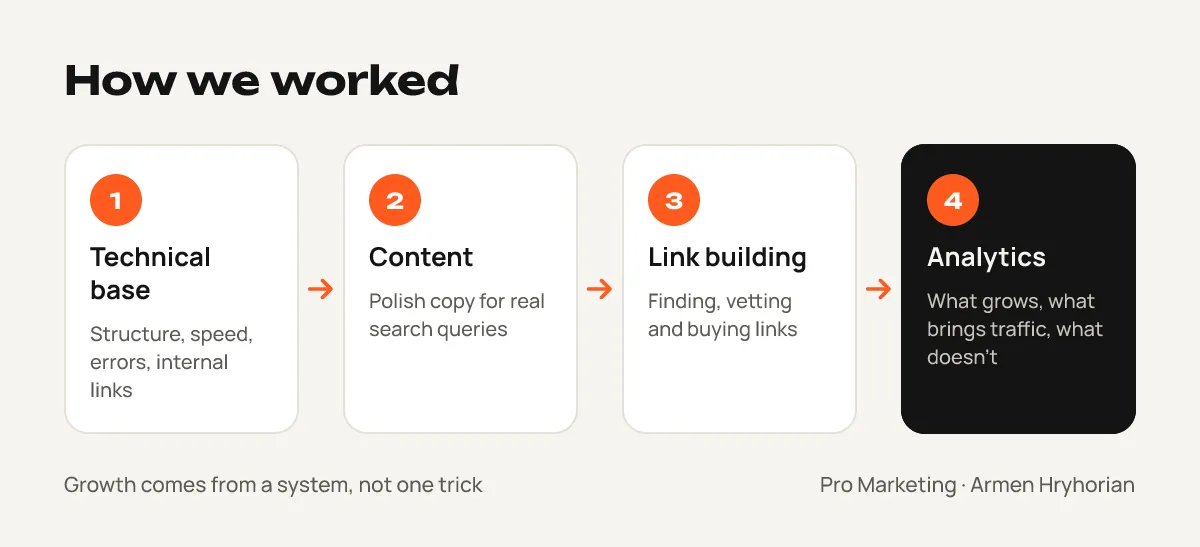
But link building never works on its own. In parallel, the team worked systematically on:
- on-page optimisation — site structure, pages for search queries, speed, technical errors, internal linking;
- content — Polish copy written for real user queries;
- analytics — every day we looked at which pages were growing, which queries brought traffic, which links really “worked” and which were money down the drain.
It was this combination — technical base + content + links + numbers — that delivered the result.
The result: 6x in a year
In a year, search traffic grew from 30,000 to about 180,000 visits — six times over. And that was in a market where competitors weren’t standing still either.
For me personally the result was even bigger: in a year I learned dozens of link-building techniques in practice, learned to assess the quality of donor sites, to understand how Google reacts to changes, and to calculate what every point of growth costs.
What made those years special: Google was still learning
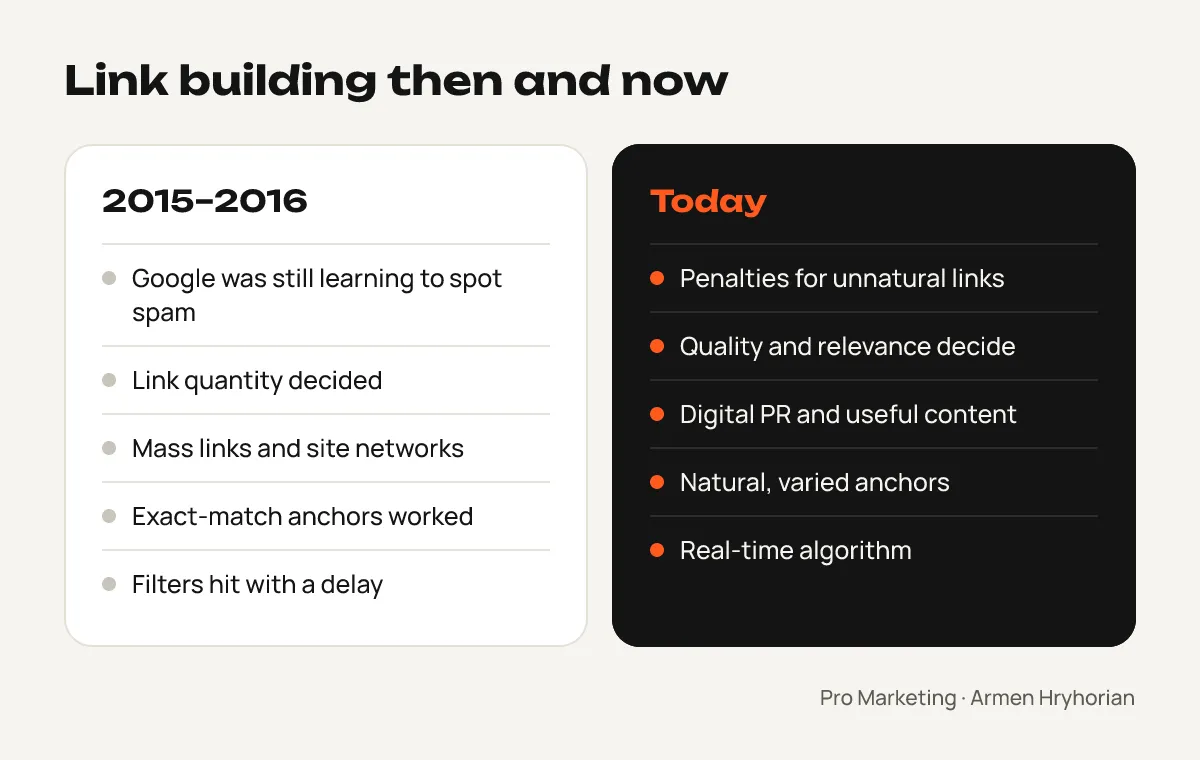
It’s important to be honest here. 2015–2016 was a different era of SEO. Google was only learning to recognise unnatural links: the Penguin filter appeared in 2012, and it only started working in real time, as part of the core algorithm, in autumn 2016.
That’s why many off-page techniques that experienced SEOs remember well still worked back then: mass links, site networks, exact-match anchors. Today most of them would get a site penalised and cost it its rankings.
What from this experience still works today:
- links still matter, but quality and topical relevance decide, not quantity;
- links won’t help without a technical base — on-page optimisation was and remains the foundation;
- analytics above all — if you can’t see what exactly drives growth, you’re just spending budget;
- a local market requires local expertise — language, culture and local sites matter more than any tool.
What the project gave me
A mentor. I was very lucky with the person who guided me all that time: he explained not only “how” but also “why”, went through my mistakes and gave me hard tasks. That’s exactly why today I do mentoring myself — I know how much a good mentor speeds up growth.
An understanding of competitive niches. Once you’ve seen the fight for the top in a niche where every position is worth thousands of dollars, any other project seems clearer.
Experience in a foreign market. Polish opened the door to IT for me, and working for the Polish market taught me to think in terms of another country. I wrote more about this in the article on why marketers need foreign languages.
The habit of counting. A link budget of $2,000+ a month teaches you fast: every expense has to be justified with numbers.
Conclusion
My first year in IT showed me the main thing: results in marketing don’t come from one magic technique but from a system. A technical base, content, external signals and analytics that ties it all together. Techniques change and Google gets smarter, but this principle hasn’t changed in ten years.
Want to understand what’s holding back your site’s search traffic right now? Start with a marketing audit. And if you’re just entering the profession, come to mentoring or a free consultation — we’ll work out where you should start.