A marketer who speaks foreign languages: how to enter international markets and earn more

Most marketers compete in a single market — their own. The same vacancies, the same clients, the same rates. A marketer who works confidently in at least one foreign language plays on a completely different field: international companies, remote work, pay in hard currency, and projects that simply don’t exist on the local market.
I speak five languages and have worked with markets in the USA, Latin America, Israel, Asia and Australia. And I can say for sure: a language isn’t “a bonus on your CV”. It’s a key that opens doors others don’t even walk up to.
Why a language is a competitive advantage
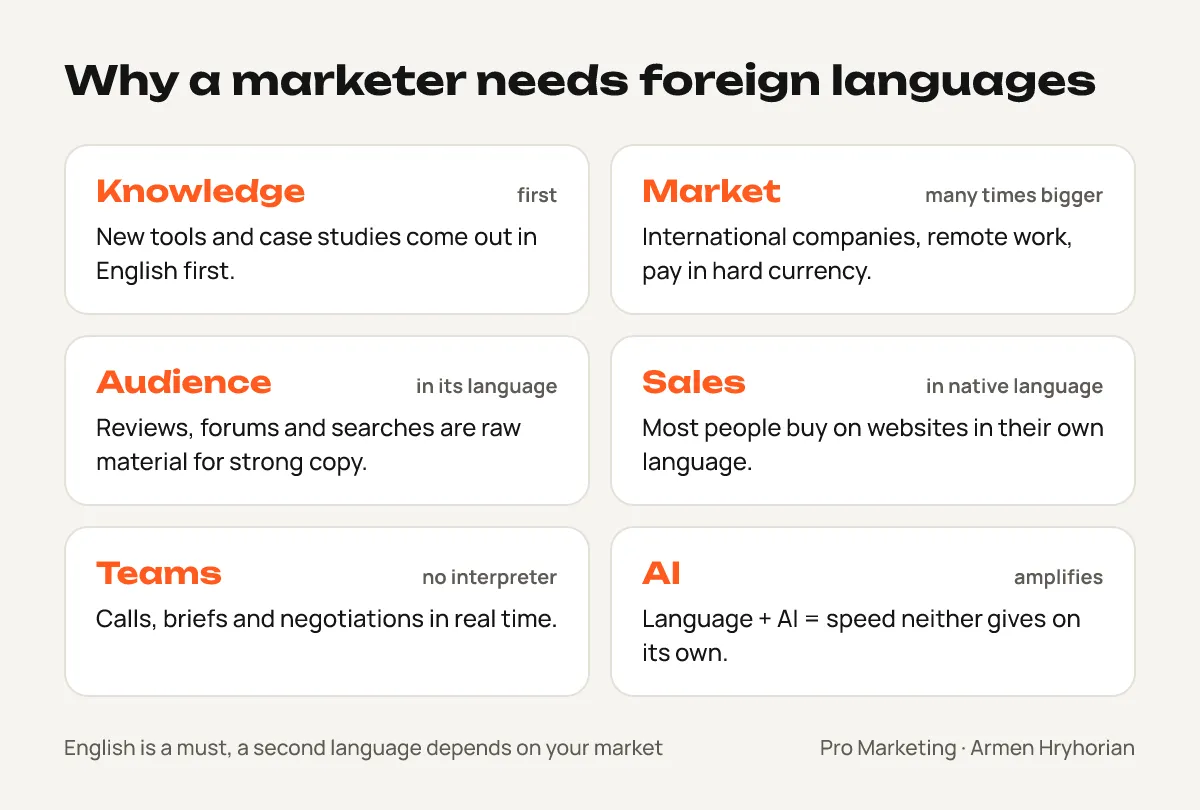
1. Access to knowledge before others
New tools, ad platform updates, case studies and research appear in English first. By the time they’re translated and retold, weeks or months have passed. A marketer who reads the original sources is always a step ahead.
2. International clients and employers
With a language you can work for companies in other countries, interview abroad and take freelance projects on international platforms. The market you’re looking for work in grows many times over — along with your choice and your rates.
3. Understanding the audience in its own language
Marketing starts with research: reviews, forums, comments, search queries. If you don’t understand how your customers talk about their problem, you can’t write copy that resonates with them. Translation carries the words, but not the tone or the pain.
4. People buy in their own language
CSA Research’s “Can’t Read, Won’t Buy” study found that most shoppers worldwide prefer websites in their native language, and a significant share won’t buy from websites in another language at all. For a business entering a new market, localised marketing isn’t a luxury — it’s a condition for sales.
5. Communicating with teams and contractors
International projects mean client calls, briefs for designers from another country, negotiations with agencies. An AI translator won’t help here: you need to hear the nuances and react in the moment.
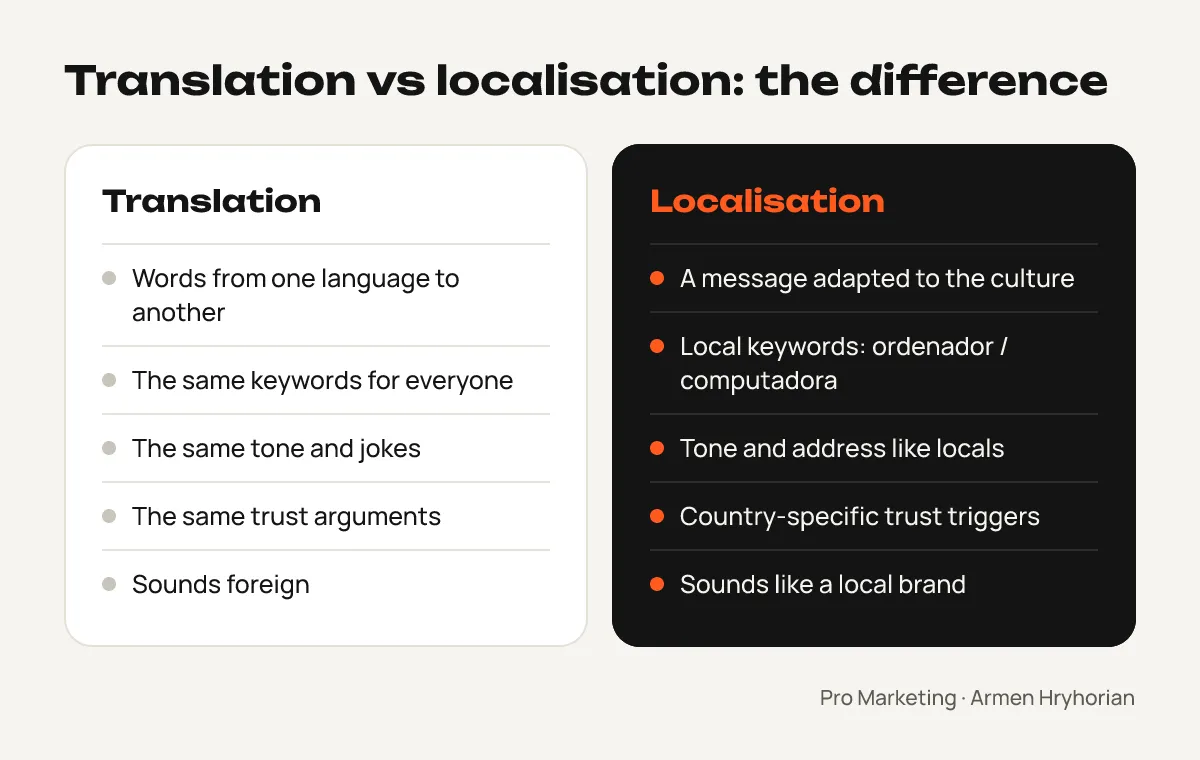
Translation ≠ localisation
The most common mistake companies make when going abroad is simply translating their website and ads. But marketing works at the level of culture, not the dictionary.
A few examples:
- Spanish: in Spain a computer is an ordenador, in Mexico a computadora. If you’re setting up search ads, these are different keywords and different audiences.
- English: in the UK it’s a holiday, in the US a vacation. A small detail that instantly gives away “foreign” copy.
- Tone and forms of address: in some places the customer expects a friendly, informal tone, in others a reserved, formal one. What sounds energetic in the US can feel pushy in another culture.
- Trust triggers: in some countries reviews and social proof persuade, in others certificates, guarantees or personal connections.
That’s why, in my experience, the same strategy doesn’t work the same way in every market. The channels, the tone, the speed of decision-making and what people trust all change.
What about AI? It translates, doesn’t it?
AI really does translate quickly and fairly well today. I use it every day myself. But it doesn’t replace knowing the language — it amplifies it:
- AI gives you a draft — you judge whether it sounds natural to a native speaker;
- AI won’t notice that a joke in your creative is offensive to a particular culture;
- AI won’t be next to you on a live client call or in an interview.
A marketer who knows the language + AI works many times faster than either of them alone.
Which languages are enough
- English is a must. B2 level to work with tools, documentation and teams. C1 to write copy and negotiate on your own.
- A second language — for your market. Choose not “the most popular” one, but the one where your clients are. Polish opens the nearby EU market, Spanish opens Spain and all of Latin America, German opens markets with high budgets.
Where to start: 6 steps
- Learn the language through your profession. Marketing blogs, podcasts and YouTube channels in a foreign language — you improve the language and stay up to date.
- Switch your tools to English. Ad accounts, analytics, CRM — you’ll learn the terminology faster.
- Build a case for a foreign market. Even a training one: a competitor analysis, a landing page or an ad campaign for another country.
- Set up your LinkedIn in English. That’s where international companies look for marketers.
- Do a few interviews in a foreign language. Even if you’re not planning to move — it’s the best practice there is.
- Check your copy with native speakers. At least the first pieces: you’ll quickly learn to hear what sounds natural and what doesn’t.
For companies: how to hire a marketer for another market
If you’re going abroad, it’s not enough to find a marketer who “knows English”. Check whether they understand the market’s culture, have worked with local channels and can adapt a message rather than translate it. I help companies with this: I interview candidates in five languages and train marketing teams to work with new markets.
Want to go international — with a growth plan, portfolio case studies and interview preparation in a foreign language? Come to mentoring or book a free consultation — we’ll figure out which market is best for you to start with.