The 8 most powerful NLP techniques for digital marketing and SMM

NLP — neuro-linguistic programming — gets mentioned in marketing either with awe or with irony. Some see it as a set of “tricks for influencing the subconscious”, others as pseudoscience.
The truth is in between. As a complete theory, NLP has no scientific backing. But several of its techniques overlap with things that are well studied in psychology and behavioural economics: the framing effect, anchoring, the power of concrete language. Those are the techniques worth bringing into digital marketing and SMM — as tools for clearer copy, not as “magic”.
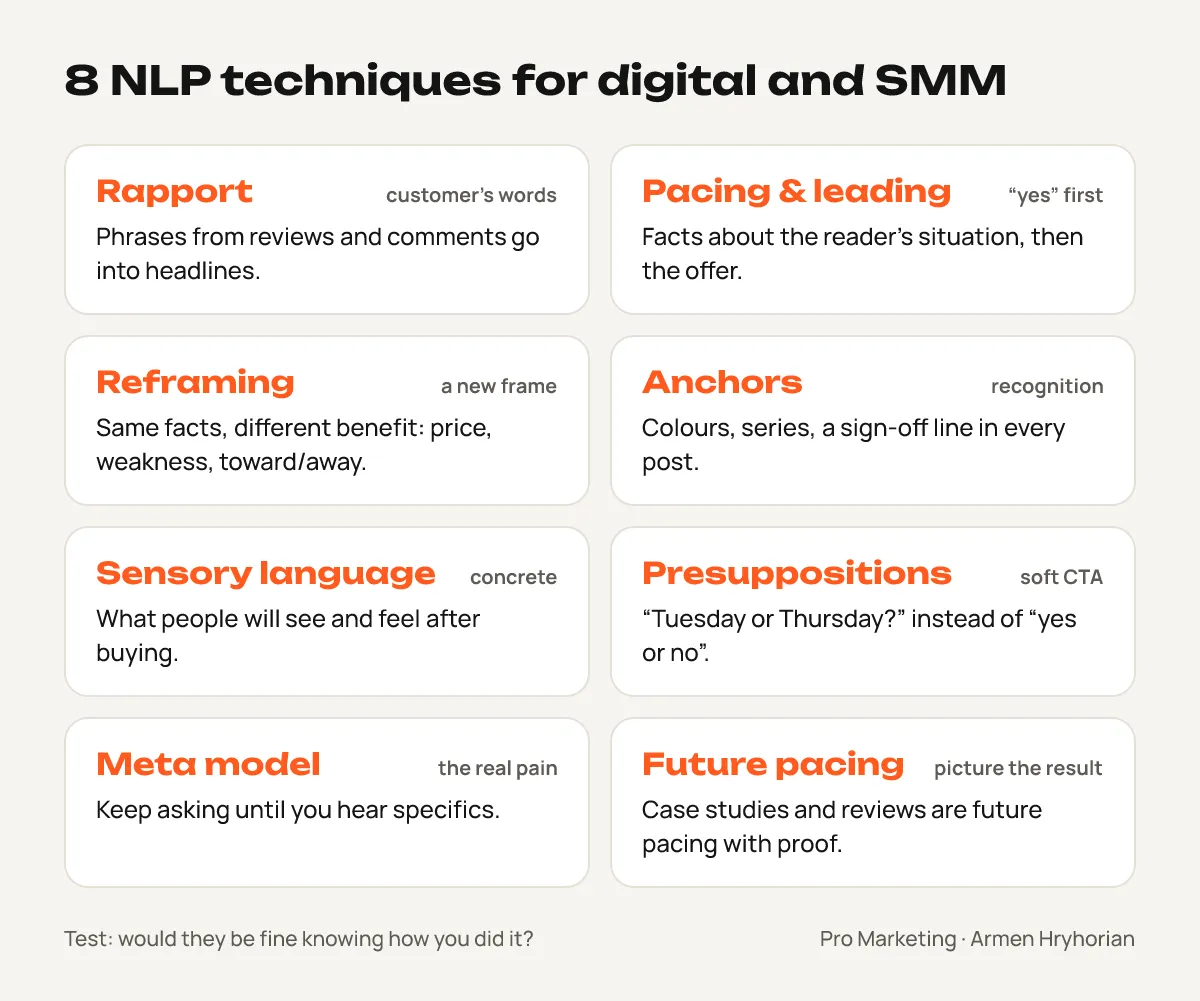
1. Rapport: speak your audience’s language
The idea: people find it easier to trust someone who talks the way they do: the same words, the same pace, the same pains.
How to use it: collect your customers’ words — from reviews, comments, DMs, call recordings. Use them word for word in headlines, ads and on your site. Not “optimising marketing processes” but “I don’t know where my ad money goes” — if that’s how your customers actually put it.
Check: read your post and ask yourself — could a customer have written this about their own situation?
2. Pacing and leading
The idea: first describe what the person agrees with (“yes, that’s me”), and only then lead them to a new idea or offer.
How to use it: in a post or ad, open with 2–3 facts about the reader’s situation, not with your product. “You post every day. You get reach. And zero leads” — and only then: “The problem isn’t how much you post. Here’s what to change.”
The trap: don’t build a “yes ladder” artificially out of obvious questions. Readers feel it and stop trusting you.
3. Reframing: change the frame, not the facts
The idea: the same facts are perceived differently depending on the frame. In psychology this is the well-documented framing effect.
How to use it:
- price: “$300 for the course” → “less than $10 a day of learning” or “cheaper than one month of a contractor who gets it wrong”;
- weakness into strength: “we’re a small team” → “you work with the people who run your project from the first call to the result”;
- toward or away from: some people respond to “get more leads”, others to “stop wasting your budget”. Test both frames in your ads.
The limit: the frame has to be true. If you get “$10 a day” by dividing the price by a year when the course lasts a month, that’s deception.
4. Anchors: associations that trigger an emotion
The idea: in NLP an anchor is a stimulus linked to a particular state. In a brand, it’s the signals you repeat: colours, recurring series, a sign-off line, the sound at the start of a video, the format of your covers.
How to use it: pick 2–3 recognisable elements and repeat them in every post and ad. Within a few weeks your audience recognises you before they read your name. Price anchoring is a separate, scientifically proven effect from behavioural economics: show the most expensive plan first, and the middle one will look like the sensible choice.
5. Sensory language instead of abstractions
The idea: NLP claims people are “visual”, “auditory” or “kinaesthetic” types. Research hasn’t confirmed this. But a related observation does hold: concrete, sensory words are remembered better than abstract ones.
How to use it: “we’ll improve your communication” → “a customer opens your site and understands what you sell within 5 seconds”. Describe what the person will see, hear and feel after buying. For video and Reels — show it, don’t tell it.
6. Presuppositions in calls to action
The idea: a presupposition is what a sentence takes for granted. “Once you book a consultation, we’ll start with an audit” sounds softer than “book a consultation”, because it already discusses the next step.
How to use it: in CTAs and sales messages: “Which suits you better — Tuesday or Thursday?”, “What matters more to you at the start — leads or awareness?”. The person chooses between options instead of deciding “yes or no”.
The limit: this works when someone is already interested. Pressuring a cold audience annoys people and hurts your reputation.
7. The meta model: questions that reveal the real pain
The idea: the meta model is a set of clarifying questions for vague statements. “We need marketing” → “What exactly should change? How will you know it’s better? What have you already tried?”
How to use it: this is the most useful NLP technique for a marketer, because it’s about research, not influence. Customer interviews, briefs, story polls, comments under posts — keep asking until you hear specifics. Those answers are where your best headlines come from (see technique #1).
8. Future pacing
The idea: the person pictures themselves after the purchase — and the decision gets closer.
How to use it: “Picture Monday morning, when by 9:00 you already know how many leads your ads brought in last week.” Case studies and reviews are future pacing too, just with proof: the reader sees someone who already got the result.
Where persuasion ends and manipulation begins
A simple test: would the person be fine finding out exactly how you did it?
- Speaking the customer’s language, showing the benefit in a clear frame, asking good questions — fine.
- Fake deadlines, false scarcity, “only 2 spots left” when spots are unlimited, pressing on fear and guilt — manipulation. It brings a short spike in sales and a long loss of trust, and ad platforms and consumer protection laws are increasingly punishing it.
NLP techniques amplify a strong offer. They won’t save a weak one — they’ll just show faster what’s wrong with it.
How to check that a technique works
Don’t take my word for it, or any NLP trainer’s. Change one element at a time and look at the numbers:
- Two ad versions: your old headline and a headline in the customer’s words. Compare CTR.
- Two landing page versions: the price stated plainly and the price in a new frame. Compare conversion rate.
- Two CTA versions: “Submit a request” and “Pick a day for a call”. Compare the number of leads.
Which metrics to watch and how to calculate them, I covered in the article on 8 metrics every marketer should know.
Want to learn to write copy that sells without pressure, and check it with numbers? We’ll work through your real posts and ads in mentoring. And for SMM and sales teams, these techniques can be part of corporate training.